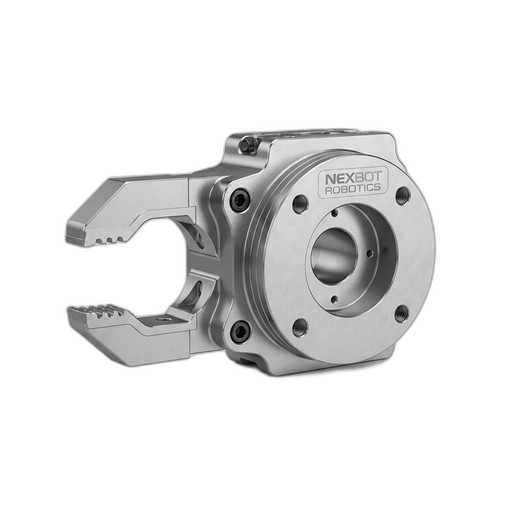
This bulletin provides a detailed technical overview of the pneumatic locking mechanism and sensor feedback system for the NexBot Robotics 421-005 Automatic Tool Changer to ensure proper integration.
Related Products
Tools Required
- Air pressure gauge
- Pneumatic tubing cutter
- Wire stripper
- Multimeter
- 5/2-way solenoid valve
Article
This document provides essential technical information for system integrators working with the NexBot Robotics 421-005 Automatic Tool Changer (SKU: NXB-GEN-421-005). Proper understanding of the locking mechanism and its integrated sensor feedback is critical for achieving safe, reliable, and efficient automated tool changing operations. This bulletin covers the principle of operation, electrical interface, integration best practices, and troubleshooting common sensor-related issues.
Principle of Operation
The NXB-GEN-421-005 utilizes a robust, pneumatically actuated locking mechanism to ensure a secure and highly repeatable connection between the robot-side master plate and the tool-side tool plate. The mechanism employs a series of hardened steel balls that are driven radially outward by a tapered piston.
- Locked State: When compressed air is supplied to the 'LOCK' port, the internal piston is driven forward. This action forces the locking balls into a V-groove on the tool plate's coupling pin. The geometry of this engagement creates a powerful, backlash-free connection capable of handling the rated 50 kg payload and 500 Nm static bending moment.
- Unlocked State: When compressed air is supplied to the 'UNLOCK' port (and vented from the 'LOCK' port), the piston retracts. This allows the locking balls to move radially inward, disengaging from the tool plate and permitting the robot to release the tool.
A key feature of this design is its mechanical self-locking capability. Even with a loss of air pressure in the locked state, the geometry of the ball-and-piston interface prevents accidental unlocking under load, providing a critical safety feature.
Electrical Interface and Sensor Feedback
The NXB-GEN-421-005 is equipped with integrated inductive proximity sensors to provide positive feedback on the state of the mechanism. These 24VDC sensors are essential for creating a closed-loop control system in the robot controller's logic.
Sensor Functions:
- LOCKED Sensor: This sensor provides a HIGH signal only when the locking piston has fully extended, confirming the tool is securely coupled.
- UNLOCKED Sensor: This sensor provides a HIGH signal only when the locking piston has fully retracted, confirming the tool is ready to be released or picked up.
- TOOL PRESENT Sensor (Optional Add-on): Some configurations may include a sensor on the master plate to detect the physical presence of a tool plate before initiating the lock sequence. This prevents the robot from attempting to lock onto an empty tool stand.
The state of these sensors should always be checked in the robot program before proceeding with any motion. For example, the robot should not move away from a tool stand until the 'LOCKED' sensor is confirmed active and the 'UNLOCKED' sensor is confirmed inactive.
Integration Best Practices
Adherence to the following practices will ensure the long-term reliability and safety of the tool changing system.
Pneumatic System Setup
- Air Supply: Use clean, dry, and non-lubricated compressed air. The recommended operating pressure is 5 to 7 bar (0.5 to 0.7 MPa).
- Valves: Control the 'LOCK' and 'UNLOCK' ports using a 5/2-way or two 3/2-way solenoid valves. For safety-critical applications, a valve with a double solenoid and a detented spool is recommended to ensure the changer remains in its last commanded state if electrical power is lost.
- Flow Control: Install flow control valves (meter-out configuration) on the exhaust ports of the control valve. This allows for adjustment of the locking and unlocking speed to prevent shock loading on the mechanism and robot wrist.
Robot Programming Logic
A robust tool change sequence is crucial. The following logic provides a basic framework:
Tool Pick-up Sequence:
- Robot moves to a pre-defined 'Approach' position above the tool in the stand.
- Robot moves to the 'Dock' position, mating the master plate with the tool plate. Use slow, precise movements.
- Program waits for the 'TOOL PRESENT' signal (if equipped).
- Energize the 'LOCK' solenoid valve.
- Program enters a monitoring loop, waiting for the 'LOCKED' sensor to become HIGH and the 'UNLOCKED' sensor to become LOW. Implement a timeout (e.g., 2 seconds) to catch errors.
- If the correct sensor feedback is received within the timeout, proceed. If not, trigger an error state and halt operation.
- Robot carefully lifts the tool from the stand and proceeds with its task.
Tool Drop-off Sequence:
- Robot moves to the 'Approach' position above the tool stand.
- Robot moves to the 'Dock' position, placing the tool securely in the stand.
- Energize the 'UNLOCK' solenoid valve.
- Program enters a monitoring loop, waiting for the 'UNLOCKED' sensor to become HIGH and the 'LOCKED' sensor to become LOW. Implement a timeout.
- If the correct sensor feedback is received, proceed. If not, trigger an error state.
- Robot carefully moves away from the tool, leaving it in the stand.
Safety Considerations
Always integrate the tool changer's sensor feedback into the robot's safety logic. The robot's motion program should be interlocked to prevent high-speed movements or the execution of a production routine unless the 'LOCKED' sensor is confirmed active. Similarly, prevent the 'UNLOCK' signal from being sent unless the robot is in a designated tool change zone and at zero velocity. Failure to implement these checks can result in a dropped tool, causing significant damage to equipment and creating a severe safety hazard.