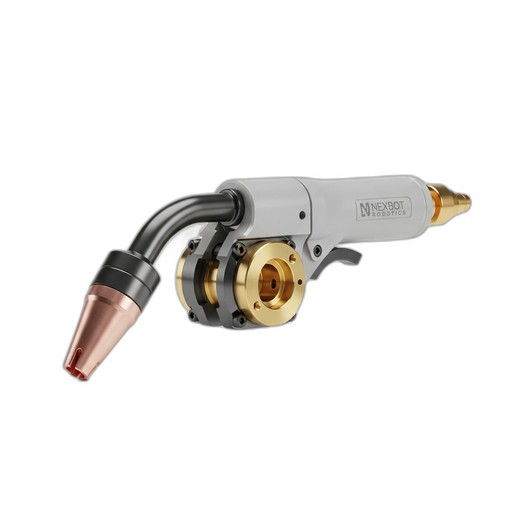
This technical bulletin provides best practices for configuring the NXB-GEN-MIG431-016 torch on NexBot robots to maximize weld quality and extend consumable lifespan.
Related Products
Article
Overview
The NexBot Robotics MIG431-016 400A Air-Cooled MIG/MAG Welding Torch (SKU: NXB-GEN-MIG431-016) is a high-performance end-of-arm tool designed for demanding, high-duty robotic welding applications. Rated for 400 amps at a 60% duty cycle with mixed gases, this torch is engineered for precision and durability on NexBot R-20, R-50, and R-100 series articulated robots. This document outlines key operational parameters and maintenance strategies to ensure optimal performance, consistent weld quality, and maximum consumable life.
Key Performance Factors
Achieving consistent, high-quality welds requires a precise balance of electrical and mechanical parameters. For the MIG431-016, operators should focus on the following core factors:
- Contact Tip-to-Work Distance (CTWD): Maintaining a consistent CTWD is critical for stable arc characteristics and predictable weld bead geometry. For this torch, a CTWD of 15-25 mm is generally recommended for short-circuit and globular transfer modes, while spray transfer may require slightly longer distances. Inconsistent CTWD, often caused by improper robot programming, can lead to fluctuations in amperage and result in defects like spatter and undercut.
- Gas Flow Rate: Proper shielding gas coverage is essential to prevent atmospheric contamination. For the MIG431-016, typical flow rates for mixed gases (e.g., 90% Argon / 10% CO2) range from 35-50 CFH (Cubic Feet per Hour). Insufficient flow can cause porosity, while excessive flow can introduce turbulence and draw in atmospheric contaminants.
- Wire Feed Speed (WFS) and Voltage: These parameters are directly linked and control the deposition rate and arc characteristics. The high-amperage capacity of the MIG431-016 allows for high WFS, enabling faster travel speeds and increased productivity. Always refer to the specific welding procedure specification (WPS) for the application. As a starting point, ensure the wire feeder and power source are calibrated to deliver the programmed values accurately.
- Torch Angle: For most applications on the J6 joint, a travel angle of 10-15 degrees (push or pull) provides the best results for bead appearance and penetration. A work angle of 90 degrees is standard for fillet welds, but may be adjusted based on the joint configuration.
Recommended Consumable Management
The longevity of consumables directly impacts operational costs and uptime. The following practices are recommended for the NXB-GEN-MIG431-016:
- Contact Tips: Due to the 400A rating, using heavy-duty copper or copper-chromium-zirconium alloy contact tips is essential. Inspect the tip orifice for signs of keyholing or spatter buildup every 4-8 hours of arc time. An oversized or obstructed orifice will lead to poor electrical contact, an unstable arc, and wire feeding issues.
- Nozzles: Ensure the nozzle is free of spatter. Spatter buildup can disrupt shielding gas flow, leading to weld porosity. Use of anti-spatter spray or dip can significantly extend cleaning intervals. The nozzle should be fully seated against the gas diffuser to prevent gas leaks.
- Gas Diffusers: Inspect the gas diffuser for blockages or damage during contact tip changes. Damaged diffuser threads or blocked gas ports will result in poor shielding and should be replaced immediately.
- Liners: Use the correct liner size for the welding wire diameter. A liner that is too large can cause the wire to wander, leading to poor arc starts. A liner that is too small will cause excessive friction and wire feeding problems. Trim liners to the exact length specified in the torch manual to prevent wire buckling.
Operational Best Practices
- Cable Management: Program robot paths to minimize sharp bends and twisting of the torch cable assembly. Excessive stress on the cable can damage internal conductors and gas hoses, leading to premature failure.
- Cooling and Duty Cycle: The MIG431-016 is air-cooled and rated for a 60% duty cycle at 400A. This means it can operate for 6 minutes out of every 10-minute period at full capacity. Exceeding this duty cycle can lead to overheating, which degrades consumables and can damage the torch itself. Ensure adequate airflow around the robot cell.
- Routine Inspection: Implement a pre-shift inspection checklist for the welding torch. This should include checking for secure connections, inspecting for external damage, and verifying the condition of the contact tip and nozzle.
By adhering to these guidelines, users of the NXB-GEN-MIG431-016 torch can achieve superior weld quality, reduce downtime, and lower overall operational costs in their automated welding processes.